Are you ready to grow up your business?



Project Information
Most forecasting advice assumes you have years of clean financial data to work from. But what if your business is only 12 months old? What if records were never kept properly, or the business has changed direction so significantly that last year’s numbers are no longer relevant?
The answer is not to skip forecasting. It’s to use a method that fits the data you actually have.
The Problem: Gaps Make Standard Forecasting Unreliable
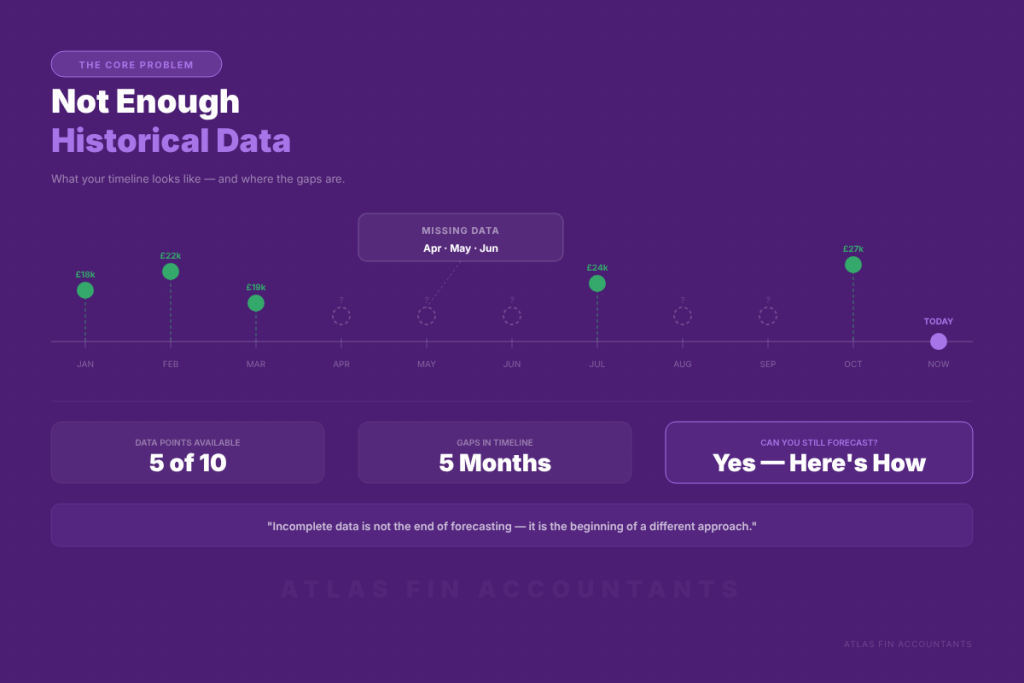
When historical data is incomplete, applying a standard trend-based forecast produces results that look precise but are built on shaky ground. Five months of revenue data cannot reliably predict the next twelve using simple extrapolation. You need to replace the missing history with structured assumptions and that requires a different toolkit.
This is more common than most business owners realise. A new company may only have two or three months of trading behind it. A business that has changed its model, pricing structure, or target market may find that older figures are no longer representative. And in many small businesses, records simply were not kept consistently in the early stages. None of these situations make forecasting impossible they just mean the standard backward-looking approach will not hold up on its own.
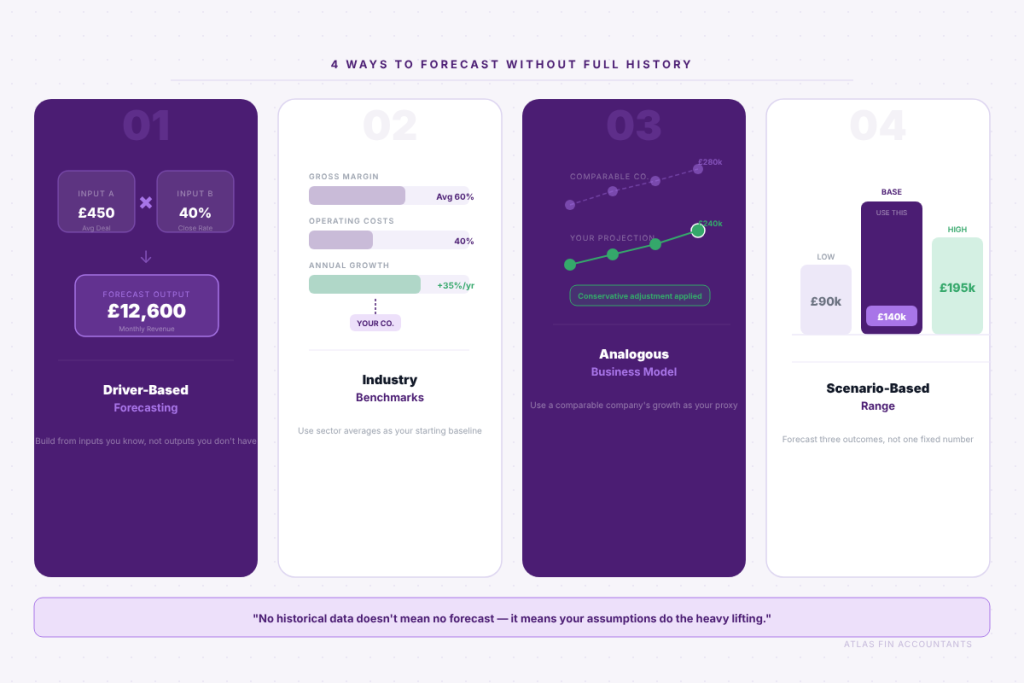
4 Methods That Work Without Full History
✓ Driver-based forecasting: Build your revenue and cost projections from the inputs you can measure: average deal size, conversion rate, number of active clients, or units sold. You don’t need historical totals if you understand your business model.
✓ Industry benchmarks: Use published sector averages for gross margin, operating costs, and growth rates as a starting baseline. Trade bodies, ONS data, and accountancy reports all publish these figures.
✓ Analogous business model: Find a comparable business of similar size in your sector and use their growth trajectory as a conservative proxy for your own projections.
✓ Scenario-based range: Instead of one fixed number, forecast three outcomes: downside, base case, and upside. When data is thin, a range is more honest and more useful than false precision.
The Most Common Mistake:
Businesses with limited data often over-rely on a single optimistic number and call it a forecast. When that number misses, confidence in financial planning collapses entirely. The fix is to treat your assumptions explicitly write them down, assign a figure to each one, and revisit them monthly as real data comes in. Over time, your assumptions become history, and your forecast becomes more accurate with every update.