Are you ready to grow up your business?



Project Information
Budgeting and Forecasting Are Not the Same Tool
Most organizations use them interchangeably. That single confusion turns performance conversations into arguments and leaves finance teams defending numbers that were never meant to predict the future.
Two Tools. Two Jobs. One Common Mistake.
Budgeting and forecasting get used interchangeably in most finance conversations. They are not the same tool. They do not answer the same questions. They do not serve the same purpose.
Treating them as one is why so many finance meetings feel like ceremonies instead of decisions. The budget gets defended long after the assumptions behind it have changed. The forecast gets treated like a moving target nobody feels bound by.
Both tools are necessary. They just need to stay in their own lanes.
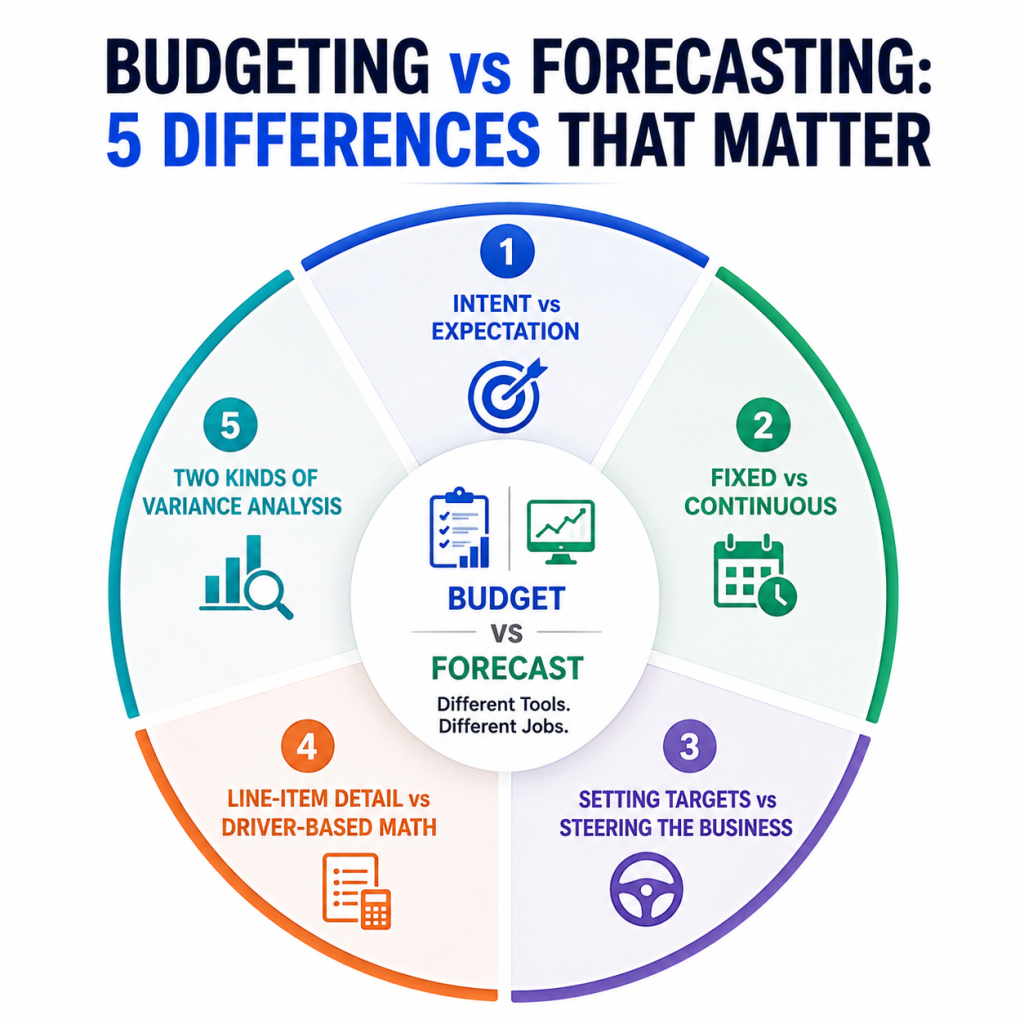
Here are the five differences that separate them.
Five Differences That Separate Budgeting From Forecasting
1. Intent vs Expectation: A budget defines what the organization intends to achieve. A forecast estimates what will actually happen. The budget is a commitment. The forecast is a prediction.
Confusing the two turns performance conversations into arguments about whether the number was ever realistic in the first place.
2. Fixed vs Continuous: Budgets are built once a year, approved, and locked. Forecasts are updated monthly or quarterly as new information comes in. A budget sits still. A forecast moves with the business.
One is a fixed stake in the ground. The other is a live reading of where the business is actually heading.
3. Setting Targets vs Steering the Business: The CFO uses the budget to set targets, communicate commitments to the board, and evaluate performance against plan. The same CFO uses the forecast to make in-year decisions on hiring, capex, and cash allocation.
Different tools. Different jobs. Neither replaces the other.
4. Line Item Detail vs Driver-Based Math: Budgets are built line by line, department by department, and consolidated up. Forecasts are built off key drivers pipeline conversion, headcount ramp, unit volume, with everything downstream calculated from those inputs.
The budget captures everything. The forecast captures what moves the number.
5. Two Kinds of Variance Analysis: Actuals vs Budget measures performance against commitment. Actuals vs Forecast measures how accurate the prediction was. Both matter. The first drives accountability. The second drives forecast quality over time.
Running only one of these analyses means missing half the picture.
The Confusion Is Not Harmless
Teams that treat the budget as a forecast get rigid. They defend the number long after conditions have changed. Every performance conversation becomes a negotiation about whether the original assumption was fair.
Teams that treat the forecast as a budget get soft. Nobody feels bound by numbers that keep moving. Accountability disappears. Decisions get deferred because the picture keeps shifting.
Both failure modes are expensive. One locks the business into a plan that no longer fits reality. The other removes the discipline that makes planning meaningful.
The fix is not a better spreadsheet. It is a clear understanding of what each tool is designed to do, and using each one for the right job.
➤ The budget tells you where you are going.
➤ The forecast tells you whether you will actually get there.
➤ Both are necessary. Neither is optional.
Is Your Business Running a Budget, a Forecast, or Both?
We help finance teams build budgeting and forecasting processes that are built for decisions, not just reporting.